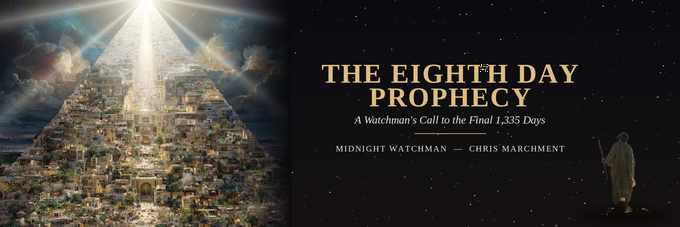
Welcome to Eighth Day Prophecy
A ministry of prophetic insight, biblical truth, and inner healing for the final days. We are living in the last hours of human history. The signs are everywhere for those with eyes to see. This ministry exists to help you understand what is happening, why it matters, and how to stand firm in the days ahead.
Here you will find prophetic teaching connecting current events to biblical prophecy, inner healing resources for those wounded by life’s storms, The Eighth Day Report — a weekly newsletter delivered to your inbox, and books to equip you for the journey ahead.
About Eighth Day Prophecy
The name confuses some people at first. The Eighth Day has nothing to do with Sunday worship or any particular day of the week — and it is worth noting that Sunday worship itself was not the practice of the early church. It was introduced by Constantine and institutionalized by the Roman Catholic Church when sun worship and Christianity were deliberately merged into a single unified state religion. The Sabbath was changed, and most of Christianity has never questioned it since. But the Eighth Day points to something far more profound than any day of the week.
God created the heavens and the earth in six days and rested on the seventh. The seven-day week is the complete cycle of this present age — from creation to its appointed end. But Scripture points beyond the seventh day to something the weekly cycle cannot contain.
The Eighth Day is the day that follows the end of this age. It is the day of new creation — eternity itself. It is the day the book of Revelation calls the new heaven and the new earth, when God dwells with His people and death is no more. It is the day Daniel’s 1,335-day blessing points toward. It is the Eighth Day — and everything this ministry does is pointed at preparing people for it.
Who Is the Midnight Watchman?
Chris Marchment is a theologian and author based in North Bay, Ontario, Canada, who has spent decades in independent study of Scripture. His theological journey began in childhood, when what he was being taught in Sunday school conflicted with what he was learning about ancient history. Rather than accepting easy answers, he began digging into the text for himself. He is also the author of the “I Am Canadian” declaration.
Formed in part through his mother’s Pentecostal ministerial training — which she passed on to him by the age of thirteen — Chris arrived at a theological framework that integrates Gap Theory, amillennialism, annihilationism, and Oneness theology, all built directly from the biblical text without dependence on the systems that have dominated Western Christianity for the past two centuries.
When he is not studying Scripture, Chris works as a torch-work glass artist, a craft that has taken him into First Nations communities across the region — an experience that has shaped his understanding of the Hidden Tribes material leading to the book being written now.
His ministry distinctively combines prophetic theology with inner healing — on the conviction that unhealed trauma makes people vulnerable to end-times deception. You cannot stand firm in what you do not understand, and you cannot understand clearly when you are carrying wounds that have never been brought to the light.
The Books
Chris is the author of six published books — available now in paperback, 16-point Large Print, and Kindle editions: Why Me, Lord? A Biblical Journey Through Inner Healing, The Eighth Day Prophecy: A Watchman’s Call to the Final 1,335 Days, Formless and Void, What God Hates: A Watchman’s Reckoning for a Nation on the Clock, The 33-66 Movement, and Dominion: North of Dependence. Explore all six books →
More titles are in development, including The Hidden Tribes: God’s Preserved People and the Final Hour.
These books exist here on-line because this message matters. If they have helped you, or if you believe they need to reach more people, consider partnering with this ministry. Your support goes directly toward the cost of printing, publishing, and placing these resources in the hands of those who need them most..
The Ministry
Eighth Day Prophecy exists for one purpose — that the people of God would know what time it is, and be ready.
The watchman has sounded the trumpet. We are that close.
About Chris Marchment — The Midnight Watchman

I grew up in a church family. Every time the doors opened, we were there — all seven of us, five children and two parents, sitting in the pew like the picture of a faithful Christian home. And in many ways it was. My mother was remarkable. She completed the full Pentecostal minister’s correspondence course and passed with flying colours — at a time when they did not license women. What she could not do in a pulpit, she poured into me. Every lesson, every doctrine, every passage — she taught it with the conviction that God is love, and she was not wrong about that. The very definition of God is love. But I kept seeing something she would move past. She would read a passage and speak on love, and I would see the prophecy buried inside it. I would see the history. I would see what Christ was actually explaining in the parable. I would see layers she never stopped to unpack — not because she wasn’t intelligent, but because the church system she had been trained in had taught her the surface and called it the depths.
That is the problem with much of the church today. It has learned a superficial interpretation of Scripture, and when it ventures into prophecy at all — which is rare enough — it is not quoting the Word. It is quoting an author, a denomination, a system built on what someone else said God said. There is no anchor in the actual text.
By the time I was fourteen, I had decided I was going to find out what God said for myself. Not what a tradition said. Not what a commentary said. What the Word itself said, in context, in history, in the original weight of its language. That search has never stopped.
It shaped me in ways I did not fully understand until much later. Childhood is where personality forms, and mine was formed in the intersection of deep Scripture immersion and deep personal suffering. The combination produced something the world does not have a comfortable category for — a man who is most alive when completely alone with God and His Word, and most depleted when surrounded by people, noise, and the relentless energy of the social world. I am an extreme introvert living in an extrovert world. A party drains me. A crowd exhausts me. Hours alone with a Bible restore me completely.
For most of my life I treated that as a defect. Something to apologize for, work around, overcome. It took decades to understand that God had designed me exactly this way — not in spite of the solitude, but for it. The independence of study that everyone else saw as isolation, God was using as formation. The introversion that kept me out of the social world kept me in the Word. What looked like limitation was actually precision engineering.
But when the church doors closed and we came home, life became something very different.
As the oldest of five children, I was held responsible for whatever any of my brothers or sister did wrong. I was supposed to be the example. That was the logic. So when they misbehaved, I was beaten — to set the standard the others were meant to follow.
Food was divided equally among all five of us. My mother believed that was fair. What it meant in practice was that at fifteen years old, I was eating the same portion as my five-year-old brother. I didn’t understand what was happening to my body at the time. I would be standing at the sink doing dishes after supper and collapse on the floor, breaking whatever I was holding. For that I would be beaten too. It wasn’t until I was an adult that I understood — I wasn’t hungry. I was starving.
There were years I would walk home from school bleeding, my shirt torn, having been beaten by a group of bullies who had decided I was worth targeting that week. I would come through the front door and my mother, curtains wide open to the street, would look at me and say: you’ve been fighting again. And she would beat me for it — while the same boys who had just done this to me stood on the road outside our window and laughed.
I share none of this for sympathy. I share it because if you are reading this and something in you recognized those words — if you know what it is to be punished for someone else’s sin, to be hungry in your own home, to bleed in front of the people who should have protected you — then I need you to know: I have been there too. This ministry was not built from a comfortable life and theological theory. It was built from the same rubble you are standing in.
At sixteen, I was abandoned — left on the side of Highway 11 in the middle of a Northern Ontario winter. No money. No plan. No one coming back. Told I do not want to see you again.
For decades after that I searched, strayed, and built walls. I became a glass artist, working with fire and molten material, shaping beauty from raw heat. I didn’t know then that God was teaching me something through that craft — that the things most worth keeping are the things that have passed through the fire.
I continued to read Scripture voraciously. Not in seminary. Not under a pastor. Alone, in the early hours of the morning, with a Bible and a burning need to understand why. Why the suffering. Why the silence. Why me, Lord.
On Thanksgiving Day, 2023, I felt something in my chest. A brief sensation — there, then gone. We had family over. It was a celebration. I dismissed it and moved on.
The next morning on my way to work, God impressed something upon me that I could not explain. Go to the hospital. Not urgently. Not in panic. Just a quiet, unmistakable knowing. What had happened the day before had felt like nothing. But I went.
The moment I described what I had felt, the medical staff recognized it immediately as a heart attack. I was admitted on the spot.
The following day, I died five times.
The first time I came back, I opened my eyes to find a nurse kneeling over me performing CPR. Her voice was the first thing I heard. Can you hear me? Can you hear me? I tried to answer. I had no voice. Nothing came. But I could hear her. I was still here.
While most heart attack victims spend two or three days in the hospital, I lay in the intensive care unit for over two months. During that time, a heart specialist stood in the hallway and spoke to my family. He was trained for moments like that one — trained to prepare people, to soften the blow, to console. Instead he told them plainly. I was not coming home. Whatever road I had travelled to get here, it had taken everything I had left. Do not expect him to survive this.
Two months later, I was rolled out of that hospital in a wheelchair.
As I passed through the corridor, I saw that same nurse. I will never forget the look on her face. She was seeing something that should not be — a man who was not supposed to be going home, going home. I do not know what she believed before that moment. But I know what I saw in her eyes. She was looking at something that defied everything she knew.
In those five crossings I saw what I can only describe as the Three Kingdoms. I saw Lucifer’s rebellion and the origin of suffering. I saw this world — humanity created knowing we would fall, Eden planted knowing the serpent would enter — and I understood for the first time that redemption reveals more of God’s glory than prevention ever could. A sinless creation shows His power. A redeemed creation shows His love, His mercy, His sacrifice, His grace. The cross displays attributes that a perfect world could never reveal.
And I saw the Third Kingdom — the eternal one. No more tears. No more pain. No more death. Every moment of my suffering suddenly light. Momentary. Compared to the glory being prepared.
What I saw also shattered much of what I had been taught about the end times. I saw hell — not as a place of eternal conscious burning, but as eternal consequence. The second death. The complete and final elimination of sin and all its effects, forever. I saw the bowl judgments not as arbitrary wrath but as the mercy of God purging what cannot be allowed to enter eternity.
And I saw Daniel’s numbers — not as the futurist tradition has interpreted them, but as Daniel himself used them. The 1,260 days marks the ministry of Christ. The 1,290 and the 1,335 are not a sequence — they begin at the same point and run in parallel, and the 45-day difference between them is the duration of the bowl judgments, the final purging before eternity opens. The seven-year tribulation that dominates modern prophecy teaching is not in Daniel. It is a construct built by reading consecutive what Daniel wrote as concurrent. The numbers were always there. The key was reading them the way Daniel laid them down.
This is what I was sent back to teach. Not what the books say. What the Word says.
I had learned years earlier how to recognize the voice of God. It is not an audible voice. It is not a conversation the way you would speak with another person. It is an impression — a quickening that rises in the back of your mind and hits with a weight so undeniable that you know, beyond all argument, that it did not come from you. It took years to learn to trust it with certainty. But I learned.
I remember once, getting ready to leave for work before a Tuesday evening Bible study at my pastor’s home. That same impression came — quiet, sudden, and clear. Bring the movie. He would enjoy watching it with his son. The film was an old one, The Gods Must Be Crazy. I grabbed it and thought nothing more of it. Hours later when I arrived, my pastor told me he had woken up that morning with a strong desire to watch that very movie with his son. He had spent the entire day searching for a free version online and found nothing. That evening I walked in holding it in my hand.
That is how God speaks to me. That is how I knew, without question, what the impression at the hospital meant. Go. And that is how I knew, in those moments between life and death, that what I heard next was not my own mind speaking.
Then I heard the commission. Not audible. Deeper than sound. A knowing that settled into my bones.
Write. Teach. Explain. Help My people understand suffering.
I want to be clear about something, because I do not want anyone to misunderstand what I am describing. I have studied and wrestled with these topics my entire life, but I do not have a photographic memory. I cannot recall everything I have ever read on command. What I believe happened — what I believe still happens — is that the Holy Spirit, living within me, draws on what decades of study have already placed in the corners of my mind, and calls it forward whenever He chooses. This was never God simply downloading information into an empty vessel. It was the fruit of years of hard study, contemplation, wrestling with the text, and unlearning what I had been taught that was wrong. That labor built the foundation. The Spirit is what allows me to recall it.
I was a glass artist. Not a writer. Not a pastor. Not a theologian with credentials. Just a broken man who had spent decades alone with God and Scripture, and who had just died five times and come back with something to say. As Jesus himself chose fishermen and tax collectors — the unqualified, the overlooked, the ones no religious institution would have selected — He chose me. Not because I was worthy. Because He was not finished.
The doctors were stunned I survived. I was not surprised. I had work to do.
Coming home was not the end of the battle. A body cannot go through what mine went through and simply return to normal life. For the six months that followed I was essentially relearning the basics of being alive — how to walk, how to carry on a proper conversation, how to move through a day without my body giving out beneath me. What had been effortless before required everything I had. It was slow, humbling, and at times frightening. But I was alive. And I had heard something in those moments between life and death that would not let me rest.
For the two years that followed, I would wake suddenly in the night — not gradually, not groggy, but instantly and completely awake. I would look at the clock. It was exactly midnight. Not 12:01. Not 11:59. Midnight. Every time. That is where these books were written. That is where the theology was revealed, chapter by chapter, page by page, in the hour the world was asleep and God had my full attention. I did not choose the midnight hours. They chose me. That is why I am called the Midnight Watchman.
I vowed as a young man never to have children — I would not pass the cycle of pain forward to another generation. God had other plans. The trauma survivors, the abandoned, the questioning, the ones who felt let down by the modern church system, but never doubted God. the ones who refuse shallow Christianity and demand truth that can bear the weight of real pain — they became my spiritual children. Every person who finds healing through this ministry is the child I swore I would never have.
I am not a seminary graduate. I am not ordained by any institution. I am a glass artist from Northern Ontario who died five times, heard the voice of God, and has been writing at midnight ever since.
That is my only credential. It is enough.
— Chris Marchment | The Midnight Watchman
